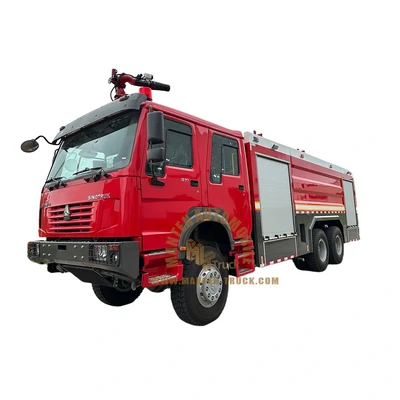
Every time the firefighting truck is started, a lot of indicator lights will light up in the middle of the dashboard, and they will automatically go out after a few seconds. This process is the self-check process of the fire fighting truck. In order to facilitate the driver to master the overall condition of the firefighting truck proficiently, it is necessary to learn various instruments on the firefighting truck to assist in understanding whether the working condition of each component is normal. The most common indicator lights usually include: door prompt, handbrake prompt, seatbelt prompt, engine self-check, lubricating oil condition check, ABS system check, airbag check, battery prompt, and fuel level prompt. Now let's learn the methods of identifying various instrument panels and the precautions for firefighting trucks together.
The oil pressure gauge is used to indicate the pressure of the engine oil in the main oil passage of the lubrication system when the engine is running, so as to understand whether the lubrication system is working properly. The oil pressure gauge of imported firefighting trucks is marked with "QIL". The engine oil pressure of the firefighting truck is determined according to the engine speed. When the pointer of the oil pressure gauge points to "0" or higher than the pressure, the engine should be turned off immediately to check the cause of the fault.
The water temperature gauge displays the temperature of the coolant in the fire fighting truck engine. The starting temperature must reach above 50℃. When the temperature is below 50℃, the engine should avoid high-speed and heavy-duty operation. The normal driving temperature should be maintained between 80~95℃. The water temperature gauge is marked with the letters H and C. The pointer pointing to the H line indicates that the temperature is too high, and the pointer pointing to the C line indicates that the temperature is too low. The pointer pointing to the position between the two letters indicates that the temperature is normal. When the pointer of the water temperature gauge points to 100℃ during driving, the main engine should be idled immediately, and the cooling system fault or coolant level should be checked. If necessary, coolant should be added.
The engine speedometer indicates the speed of the engine per minute. When adjusting the engine idle speed, the speed should be checked. Check the engine speed that the firefighting truck maintains the highest efficiency. When checking the engine speed of the firefighting truck within the specified time, it is necessary to avoid exceeding the speed limit specified in the manual. The tachometer is marked with a red warning line value. When the speed value reaches the red warning zone, the throttle or gear shift should be reduced to reduce the engine speed.
The ammeter is used to indicate the value of the charging or discharging current of the battery and monitor whether the charging system is working properly. The number on the dial represents the size of the charging and discharging current, and its unit is A. The normal pointer value in the ammeter: the charging value, the reading of the pointer is 4~5A. When the fire fighting truck is idling, the pointer points to the "-" side. When the battery is in a saturated state, the pointer is at the "0" position. According to the swing of the pointer, the power supply current situation and its low-voltage circuit fault can be judged.
The instrument panel is the most intuitive performance of the firefighting truck driving status. The appearance of these faults will directly damage the vehicle and may risk driving safety.
The water temperature warning light is generally too low. The indicator light is blue, and red indicates that the temperature is too high. Some cars identify the condition of antifreeze and other liquids by the brightness of the light. If you do not pay attention to changes in water temperature, extreme conditions may cause cylinder body deformation and other situations, which is not worth the loss.
The firefighting truck may light up when the vehicle is started. If it keeps on, there will be a problem. This is generally because the oil level is lower than the standard value, and continuing to drive will cause wear and tear.
Under normal circumstances, this light is not lit. If this light lights up, it is very likely that your tire pressure is insufficient or the tire is damaged. It is recommended to check the tire pressure and inflate the tire in time. If the tire bursts, it is very dangerous.
The fire fighting truck will light up shortly after starting, which is a normal phenomenon. If the warning light is still on after driving for a period of time, it means there is a problem with the ABS system. ABS is related to the brake system and is a safety barrier for our driving. We must take it seriously if there is a problem and repair it in time.
First, check if you have released the handbrake. If the handbrake has been released and the light is still on, please check whether the brake oil is missing or the brake pads are too thin. If you still can't find the reason, you should go to the repair shop as soon as possible to fix the car.
The instrument panel indicator lights of firefighting trucks are varied, and even many drivers dare not say that they can understand all of them while driving. At ordinary times, firefighters should pay more attention to learning to avoid being at a loss when the indicator light suddenly lights up while driving the firefighting truck.
Fuel Efficiency and Performance With Isuzu Prime MoverJuly 12, 2024In the world of heavy-duty transportation, the choice of a prime mover plays a pivotal role in determining efficiency and performance. MANTEN, a brand synonymous with innovation, introduces the Isuzu ...view
Do You Know the Development Trend of Truck?July 12, 2023The formal name of trucks is load-carrying vehicles, which are a form of automobile used for carrying goods and commodities, including dump trucks, tractor trucks, off-road and off-road area offroadin...view
Choosing the Perfect Prime Mover for Your Needs: A Comprehensive GuideJune 21, 2023IntroductionWhen it comes to heavy-duty transportation and logistics, selecting the right prime mover is crucial. A prime mover serves as the powerhouse of any fleet, providing the necessary strength ...view
Tow Truck Brands: What Fleet Owners Should Consider Before Investing in a Recovery VehicleJuly 1, 2026The towing and recovery industry relies heavily on equipment performance, reliability, and long-term operating costs. While many buyers focus on towing capacity or initial purchase price, choosing amo...view
Trucking: What You Need to Know About TruckingSeptember 30, 2022What is trucking?When it comes to the road transport of goods by motor vehicles, the trucking sub-sector is responsible for the transport. This sub-industry can be divided into Specialty Freight and G...view
Record the Delivery of 27 meters aerial platform truck for exporting project.August 29, 2023In a recent development, a batch of 27-meter JMC brand high-altitude operation vehicles has been successfully completed and dispatched. These vehicles are designed to cater to various high-altitude op...view