With the improvement of living standards and changes in lifestyle, people need more frozen foods, preserved foods, milk, fresh flowers, and large food processing enterprises. "Cold chain logistics" has also become a popular term in the transportation industry, and fridge trucks occupy a key position in ensuring the safety of perishable and fresh foods during transportation in low temperature cold chain logistics.
Fridge trucks are mainly composed of a car chassis, a heat-insulated and insulated compartment, a refrigeration unit, and a temperature recorder in the compartment. For vehicles with special requirements, such as meat hook trucks, optional parts can be added, such as meat hooks, waist restraints, aluminum alloy rails, and ventilation channels.
Refrigerated vehicles are actually called refrigerated and insulated vehicles, which are divided into two categories: fridge trucks and insulated trucks.
Classification by refrigeration method:
Mechanical refrigerated vehicles, freezing plate refrigerated vehicles, liquid nitrogen refrigerated vehicles, dry ice refrigerated vehicles, ice refrigerated vehicles, among which mechanical refrigerated vehicles are the main models of fridge trucks, and most fridge trucks are also mechanical fridge trucks.
Classification by chassis carrying capacity:
Mini fridge trucks, small fridge trucks, medium fridge trucks, and large fridge trucks.
Classification by compartment type:
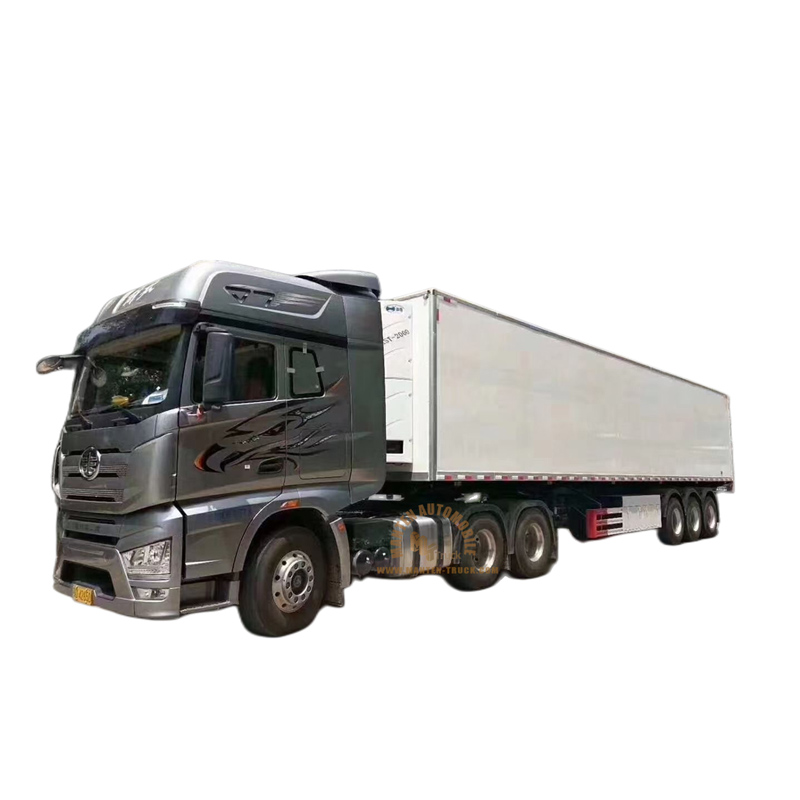
Bread-shaped fridge trucks, compartment fridge trucks, and semi-trailer fridge trucks.
Chassis
When selecting a chassis, users need to consider the structure and carrying capacity, fuel efficiency, emission standards, etc. of the chassis based on the tonnage and road conditions of the goods. The choice of a car chassis is relatively easy.
Compartment selection
The selection of the compartment depends on the specific goods transported. Different goods have different requirements for the compartment. For example, a fridge truck for transporting fresh meat needs to customize hooks on the compartment; a fridge truck for store distribution has a small batch size, multiple varieties, and requires a multi-temperature fridge truck; if temperature requirements vary and loading and unloading are frequent, a fridge truck with multiple doors is needed. Users can customize the compartment to meet their specific needs.
Material of the compartment
The design of the refrigerated compartment is mainly based on airtight performance and insulation performance. Usually, the structure of the fridge truck adopts a three-layer structure, and the internal and external skins are composed of composite materials, such as fiberglass panels, color steel plates, aluminum alloys, and other materials.
The material of the inner panel should be different for different transported goods. The most expensive inner material should be stainless steel plates. The intermediate layer is filled with insulation materials, mainly polyurethane foaming materials. The four sides are bonded together with high-strength glue to form a closed panel.
Thickness of the compartment
In addition to materials, the thickness of the compartment also determines the insulation effect. The thicker the insulation layer of the compartment, the better the insulation effect, but the internal space of the compartment will decrease and the loading capacity of the goods will decrease. Users need to choose a suitable thickness based on their actual needs.
Refrigeration unit
Choose according to the size of the refrigerated compartment: an independent unit or a non-independent unit can be used.
Choose according to the requirements of the fridge truck for distribution: for example, if the fridge truck is used to deliver ice cream in the city, a cold storage unit or an independent unit must be selected. Only long-distance or inter-city small-scale distribution is suitable for using a fan-type refrigeration unit.
Be sure to pay attention to whether the temperature sensor of the unit is installed at the return air position of the evaporator, because the temperature reading will differ by 5℃ if the temperature sensor of the unit is installed in the return air or exhaust position.
Revolutionizing Live Fish Transport: The Manten Fish Carrier TruckJune 7, 2023Introduction:The transportation of live fish is a critical aspect of the aquaculture industry. Ensuring the well-being and safety of fish during transit is crucial to maintain their quality and value....view
What Are the Methods and Precautions for Identifying Dashboard Indicators on the Firefighting Truck?July 12, 2023Every time the firefighting truck is started, a lot of indicator lights will light up in the middle of the dashboard, and they will automatically go out after a few seconds. This process is the self-c...view
Advantages of Bulk Feed Delivery TrucksJune 6, 2025Bulk feed delivery trucks, as important transportation tools in the modern livestock industry, have many advantages that traditional transportation methods cannot compare to. They are widely used for ...view
How to Choose the Right Fire Fighting Water Cannon for Industrial and Emergency ApplicationsJuly 1, 2026Fire safety professionals, industrial facility managers, and emergency response teams all face the same challenge: controlling fires quickly while protecting personnel and assets. One of the most effe...view
Wholesale Live Fish Transport Trucks: Enhancing Efficiency, Sustainability, and WelfareJune 8, 2023Introduction:Transporting live fish from fish farms to wholesalers or retailers is a crucial aspect of the seafood industry. It requires specialized equipment to maintain optimal water quality, temper...view
Record the Production of 16-Seater Bus for Exporting ProjectJuly 25, 2024We are pleased to announce that our company has successfully dispatched a consignment of 4x2, 16-seater buses to international clients, reinforcing our position as a leading exporter of high-quality t...view