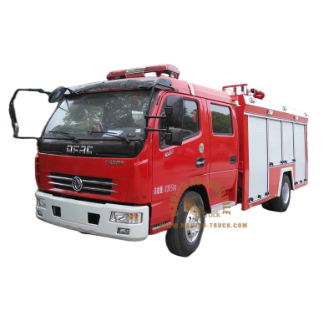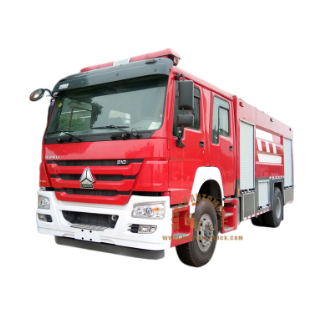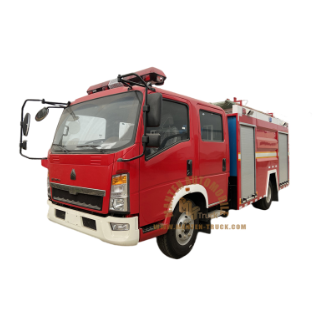
Firefighting truck water cannons are composed of a base, inlet pipe, rotating body, water collecting pipe, jet regulation ring, handle, and locking mechanism. The gun body can be rotated horizontally and vertically, and can be fixed in position. The cannon has a wide pressure range, with a far range and infinitely adjustable direct flow to 90° blossom and water mist jet. Its light weight, small size, complete functions, and good fire extinguishing effect are the biggest characteristics of the gun. Foam guns mainly consist of a handle, base, inlet pipe, rotating body, locking device, foam spray system, and rotating mechanism.
Water cannons should be used within the specified pressure range.
Adjust the swing range, jet, and elevation angle according to the fire site.
Place the fire fighting truck water cannon in an appropriate position at the disaster site and connect it to the fire hose for water supply.
The integrity and mobility of the cannon should be checked regularly. If any fasteners become loose, they should be repaired promptly to keep the cannon in good working order.
During water spraying operations, release the locking screw, adjust the jet direction and angle, and then increase the pressure to the appropriate level.
Turning the jet regulation ring can switch the water stream from direct flow to blossom or from blossom to direct flow.
After each use, the cannon should be sprayed with clean water for a period of time and then drained of water.
Absolutely do not stand in front of the muzzle while the water cannon is spraying.
Firefighting truck water cannons should not be used to extinguish fires involving live electrical equipment to avoid electrical shock.
The rotating parts of the water cannon should be regularly lubricated to ensure flexibility of movement.
When not in use, the firefighting truck water cannon should be positioned horizontally and covered with rainproof material.
Adjust the swing range, jet, and elevation angle meticulously, in a coordinated and scientific way.
The water supply pressure must be maintained above 4 kilograms.
The integrity and mobility of the cannon should be checked regularly, and if any fasteners become loose or deformed, they should be repaired promptly to keep the cannon in good working order.
Water cannons should be used within the specified pressure range.
The ball valve on the firefighting truck water cannon should be opened or closed within the specified pressure range to avoid damaging the ball valve and sealing parts.
The rotating parts of the water cannon should be regularly lubricated with grease to ensure flexibility of movement.
Clean water should be used to avoid damaging the ball valve or clogging the firefighting truck water cannon.
Firefighting truck water cannons should not be used to extinguish fires involving live electrical equipment to avoid electrical shock.
After each use, the cannon should be sprayed with clean water for a period of time and then drained of water. In winter, in severely cold areas, there must be no water in the water cannon to avoid freezing and damage.
Personnel entering the disaster site must wear appropriate protective equipment to prevent injury.
Try to avoid external factors affecting the swinging of the water cannon to prevent damage.
After completing the task, the firefighting truck water cannon and everything surrounding it must be thoroughly cleaned.
A quick-disconnect rain cover can be used to protect water cannons in rainy weather.
The fire fighting truck water cannon is an important firefighting equipment for long-distance firefighting, and is divided into two major series: fire water cannons (PS) and foam fire cannons (PP). Fire water cannons use water as a medium to extinguish fires from a distance for general solid materials. Foam fire cannons spray air foam to extinguish class A, B, and C liquid fires from a distance. Fire water cannons use water as a medium to extinguish fires from a distance.
|
|
|
What Are the Factors that Affect the Low Working Temperature of Spark Plugs in Fire Fighting Trucks?July 12, 2023The working environment of spark plugs is extremely harsh, as they have to withstand high temperatures, high pressures, and corrosive exhaust gases after combustion. Nevertheless, the working temperat...view
Seven Precautions for Sanitation Sprinkler Trucks to Prevent Tire BlowoutsMay 22, 2023Water trucks generally operate in urban areas, and a tire blowout can have a significant impact on the safety of surrounding citizens. Therefore, it is essential to take precautions to avoid tire blow...view
Emergency Response Reinvented: Dry Powder Fire Trucks for Rapid Fire SuppressionNovember 13, 2023When a fire emergency strikes, swift and effective response is paramount. In such scenarios, traditional water-based firefighting methods might not always be the most efficient solution. Enter dry pow...view
Record the production of Bulk feed tank truck for exporting projectAugust 29, 2023At the end of summer and the beginning of autumn, the weather outside the workshop was still scorching hot, and the workers in the workshop were in full swing to manufacture our company's new alum...view
Record the Production of 16-Seater Bus for Exporting ProjectJuly 25, 2024We are pleased to announce that our company has successfully dispatched a consignment of 4x2, 16-seater buses to international clients, reinforcing our position as a leading exporter of high-quality t...view
What Are the Methods and Precautions for Identifying Dashboard Indicators on the Firefighting Truck?July 12, 2023Every time the firefighting truck is started, a lot of indicator lights will light up in the middle of the dashboard, and they will automatically go out after a few seconds. This process is the self-c...view